Ask people what they noticed after their first traditional Thai massage and the answer is rarely "I was so relaxed." It is usually about movement. Bending to tie a shoe without a grunt. Checking a blind spot without turning the whole torso. Getting off the couch in one go.
That is the clearest of the Thai massage benefits, and the one that sets it apart from oil massage. It is built around assisted stretching, so the main thing it changes is how freely you move. Many guests also find it leaves them calmer and, unusually for a massage, more awake. Below is what sits behind each of those, what the evidence does and does not say, and who should talk to a GP before booking.
What guests commonly notice
Looser hips and hamstrings
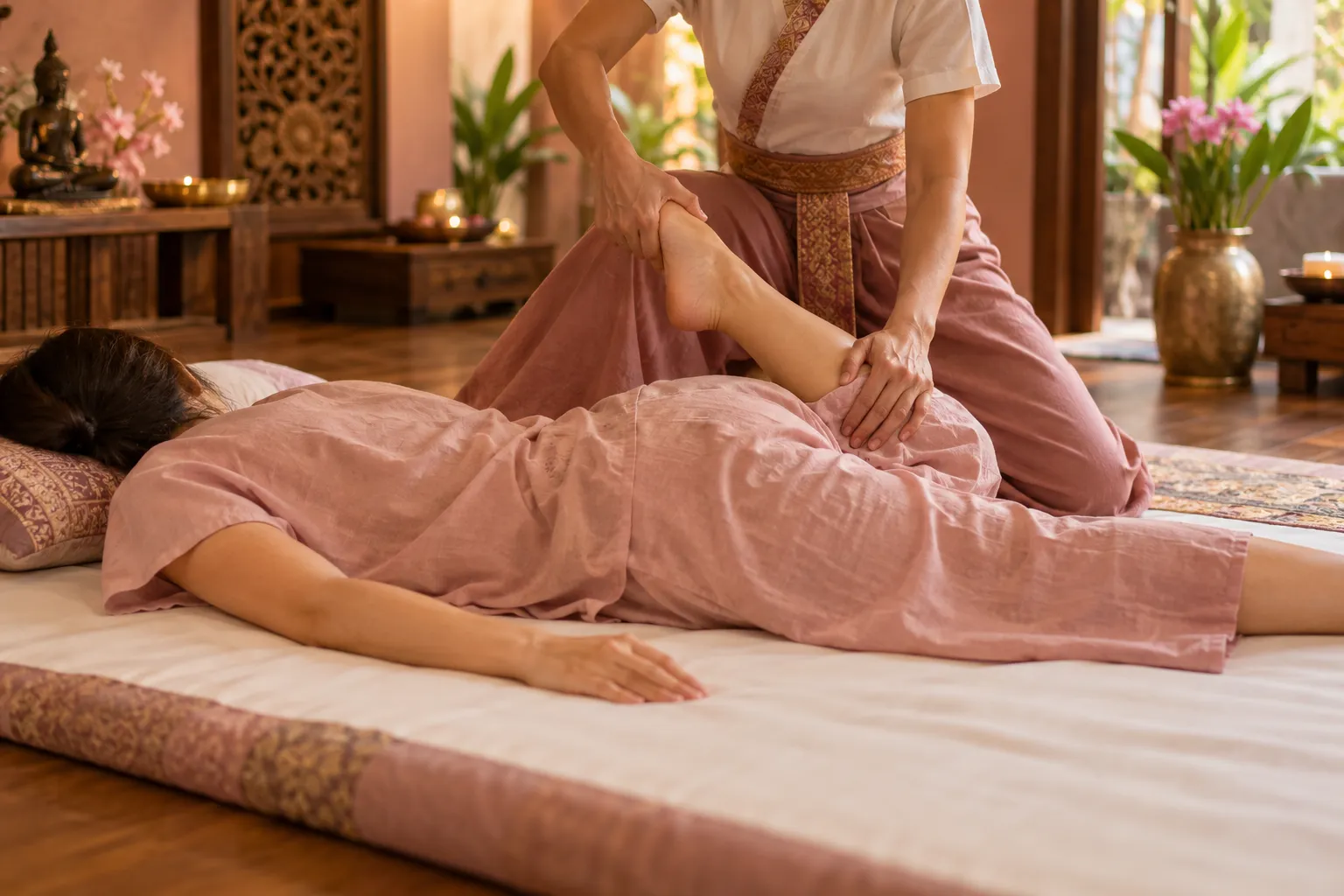
Long days in a chair shorten the front of the hips and tighten the backs of the legs. Thai massage gives a generous share of the session to exactly those areas, with knee-to-chest folds, leg lifts and slow rotations of the hip, and the stretch is held for you, so the muscles are not also working to hold your leg up. Many people stand up afterwards feeling taller than when they lay down.
Easier everyday movement
The change shows up in ordinary moments over the next few days: reversing out of a car park, reaching a high shelf, climbing stairs without the lower back complaining. Our own menu describes traditional Thai massage as tailored to easing lower back pain, arthritis, headaches and stress-related tension, and that kind of tension often shows up as stiffness long before it shows up as pain.
A calmer head
The rhythm matters here. Pressure that presses, releases and moves on at a steady pace is predictable, and predictable touch is one of the clearest signals your body gets that it can stand down. Our piece on the science of touch and stress explains the nervous-system side of this in more detail.
Energised rather than sleepy
This one surprises people. Oil massage tends to send guests out soft and drowsy. Thai massage more often sends them out alert: lengthened, warm and ready to get on with the day. That makes it a good lunchtime or pre-dinner booking, and a less obvious choice for a late wind-down right before bed.
Why it works: stretch, compression and the sen lines
Three things are happening at once, and each makes the others work better.
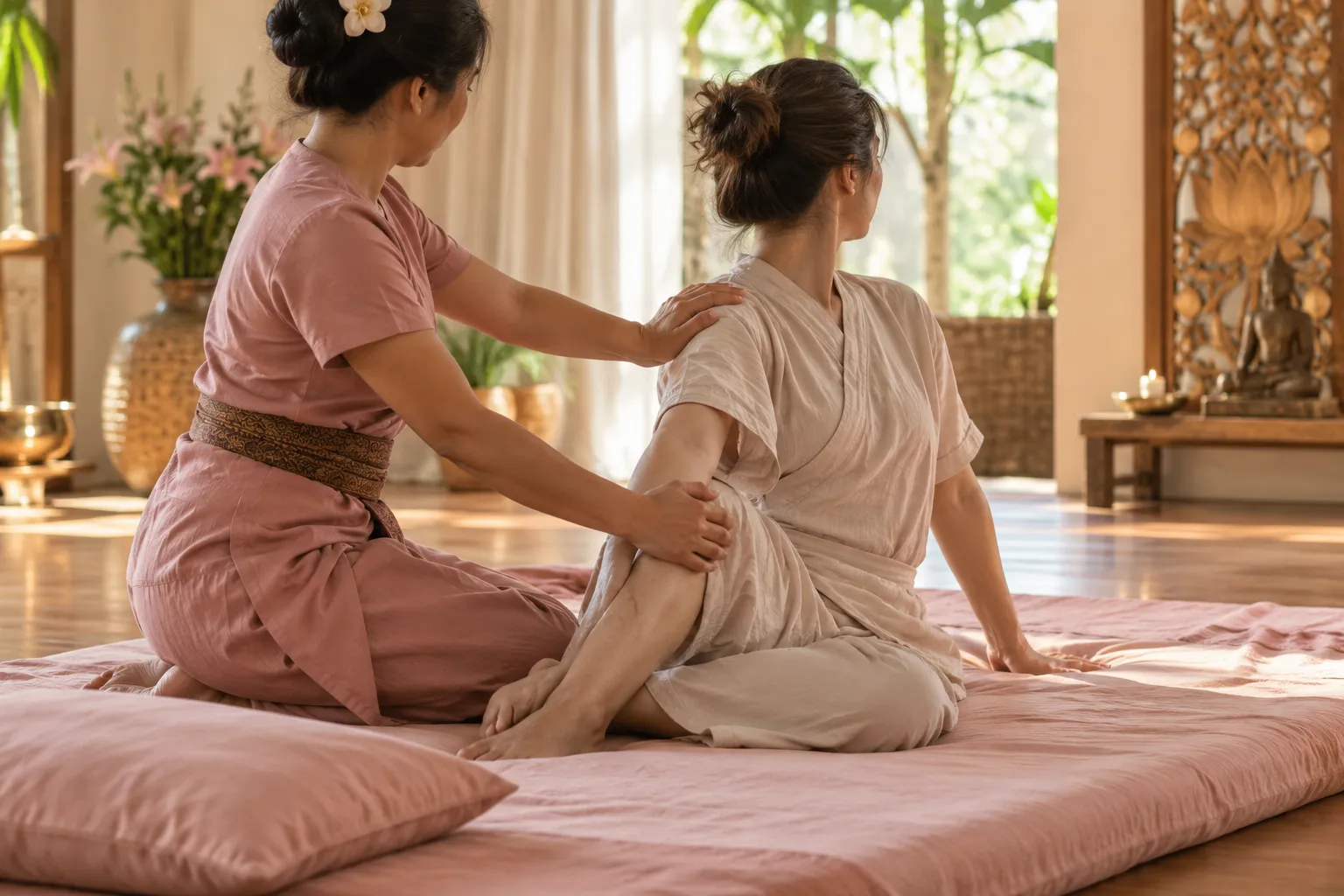
- Passive stretching. You do not hold the stretch; the therapist does. Because you are not working to support your own limb, the muscle can lengthen without guarding, which is why the stretches often go further than they would in a yoga class.
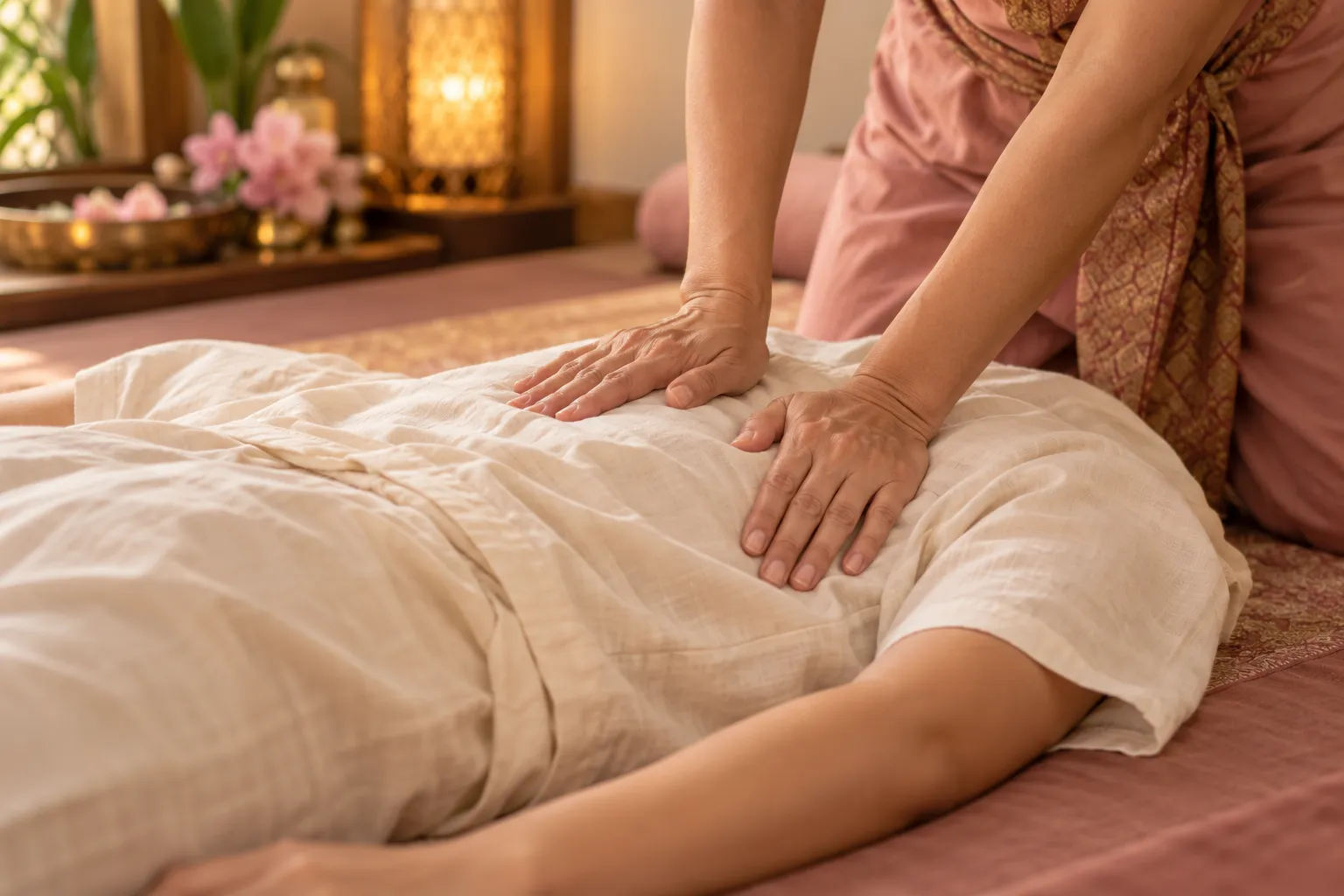
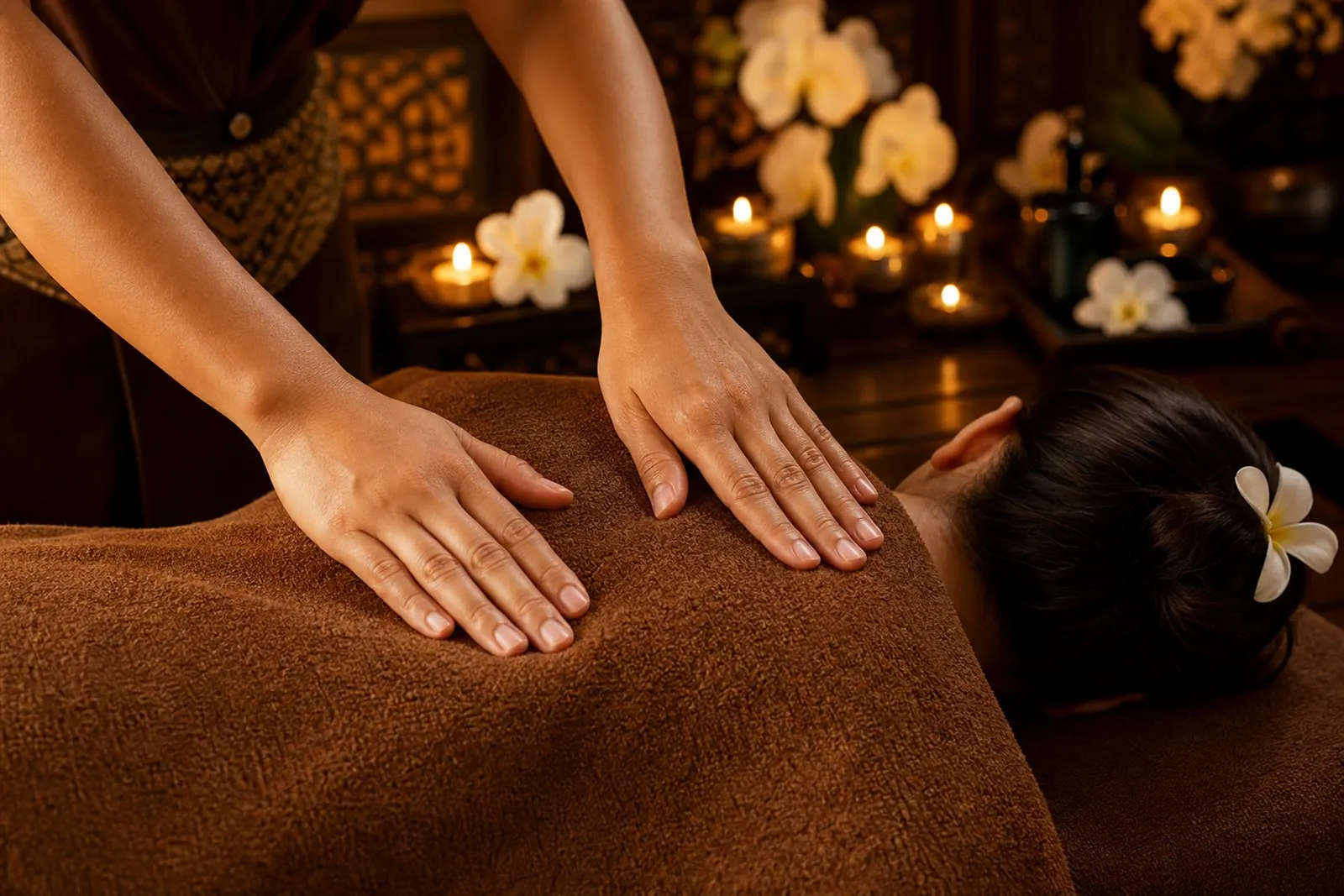
- Rhythmic compression. Palms and thumbs press and release in a steady wave, warming the tissue before the stretch that follows. It feels less like being rubbed and more like being pressed out, like dough under a rolling pin.
- Acupressure along the sen lines. In Thai tradition the body is crossed by energy lines called sen, and the pressure follows them. UNESCO's entry on Nuad Thai describes the traditional belief that ailments come from blocked energy along these lines. Treat that as the tradition's map of the body rather than a medical claim. The practical point is that the pressure follows long lines from feet to head, so nothing gets skipped.
"One session shows you where you are stiff. Three or four, a few weeks apart, show you it can change."
Siri therapist team
Who tends to get the most out of it
Thai massage is not a better massage than an oil massage, just a different one. The people who tend to notice the biggest difference are the ones whose problem is movement rather than one sore spot:
- Desk workers and long-distance drivers, whose hips and hamstrings spend most of the day folded and shortened
- Runners, cyclists and walkers who skip their stretching, and know it
- People who find gyms and yoga classes off-putting but would like to move more easily
- Anyone who dislikes oil or undressing, since the whole treatment is done clothed
- People who want to feel awake afterwards, because they are heading back to work or out for the evening
If what you have is a single stubborn knot rather than general stiffness, deep tissue may suit you better. Our comparison of Thai massage and deep tissue sets out how to choose between them.
What the evidence says about Thai massage benefits
Thai massage has been studied less than western massage, and much of the research is small. Cleveland Clinic's overview of Thai massage sums up its likely benefits as better flexibility and range of motion, some relief for back pain and headaches, and lower stress. Most are framed as things it may help with rather than promises, which is a fair way to hold them.
What it is not: a treatment for any disease, a replacement for physiotherapy, or a fix for an injury. If you have a diagnosed condition, think of Thai massage as something that may make you more comfortable alongside your proper care, not instead of it.
Making the benefits of Thai massage last
Gains in flexibility fade if nothing reinforces them. A few habits help the looseness stick around for longer:
- Book 90 minutes if you can. The hip and leg work is where most of the change happens, and it is the first thing to be squeezed in a shorter session.
- Tell your therapist your goal. "I want to touch my toes again" or "my hips lock up on long drives" changes where the time goes.
- Move gently the same day. A walk is ideal. A heavy leg session at the gym is not.
- Repeat one stretch at home. Ask your therapist for the single stretch that matters most for you, and do it while you brush your teeth.
- Come back while you still feel it. Many guests find a session every three or four weeks keeps the gains from sliding. Leave it a few months and it can feel like starting again.
Who should check with a GP first
Because Thai massage involves stretching, body weight and joint movement, it suits some bodies less well than others. Check with your GP, specialist or physiotherapist before booking, and tell us when you book, if you have:
- osteoporosis, or a history of fractures
- heart disease, or high or unstable blood pressure
- diabetes, especially with reduced feeling in the feet or legs
- cancer, or are having cancer treatment
- a joint replacement, disc problems or hypermobility
- a recent injury or recent surgery
If you are pregnant, talk to your midwife first. Traditional Thai stretching is generally not recommended in pregnancy, and Siri does not offer a dedicated prenatal massage. Our guide to massage in pregnancy explains what to discuss with your midwife before booking anything.
And one honest limitation for everyone: Thai massage will not undo months of sitting in an hour. It shows you where the stiffness is and gives you a head start. Keeping it away is the part you do between visits.
Booking a Thai massage at Siri
Traditional Thai massage is on the menu at both spas, open seven days from 10.00am to 8.00pm. At the Viaduct in the CBD it is $65 for 30 minutes, $115 for 60, $165 for 90 and $220 for 120. At St Heliers on Tamaki Drive it is $60, $105, $145 and $195. For a walk-through of a session from start to finish, read our guide to traditional Thai massage in Auckland.
Common questions
Many guests notice looser hips and hamstrings, easier everyday movement, a calmer head, and feeling energised rather than sleepy. It works mainly through assisted stretching and rhythmic pressure, so its biggest effect is on how freely you move.
Many people with everyday lower-back stiffness find it eases, because Thai massage loosens the hips and hamstrings that pull on the lower back. If back pain follows an injury, or comes with numbness or leg weakness, see a GP or physiotherapist first.
For ongoing stiffness, many guests find every three to four weeks keeps the gains from sliding. For an occasional reset, book whenever you notice you have stopped moving freely.
Traditional Thai stretching is generally not recommended in pregnancy, and Siri does not offer a dedicated prenatal massage. Talk to your midwife first, then phone the branch to discuss what may suit you.