Type "Thai massage Auckland" into your phone and the word Thai turns up in front of all sorts of treatments. Some involve warm oil and a towel. Some involve being stretched like a yoga class you did not have to attend. Only the second is traditional Thai massage.
So here is the short version. Traditional Thai massage, called nuad Thai in Thailand, happens fully dressed and oil-free, built from rhythmic acupressure and assisted yoga-style stretches. You are moved, not just rubbed. You can book it at both Siri spas in Auckland: the Viaduct in the CBD and St Heliers on Tamaki Drive.
What traditional Thai massage actually is
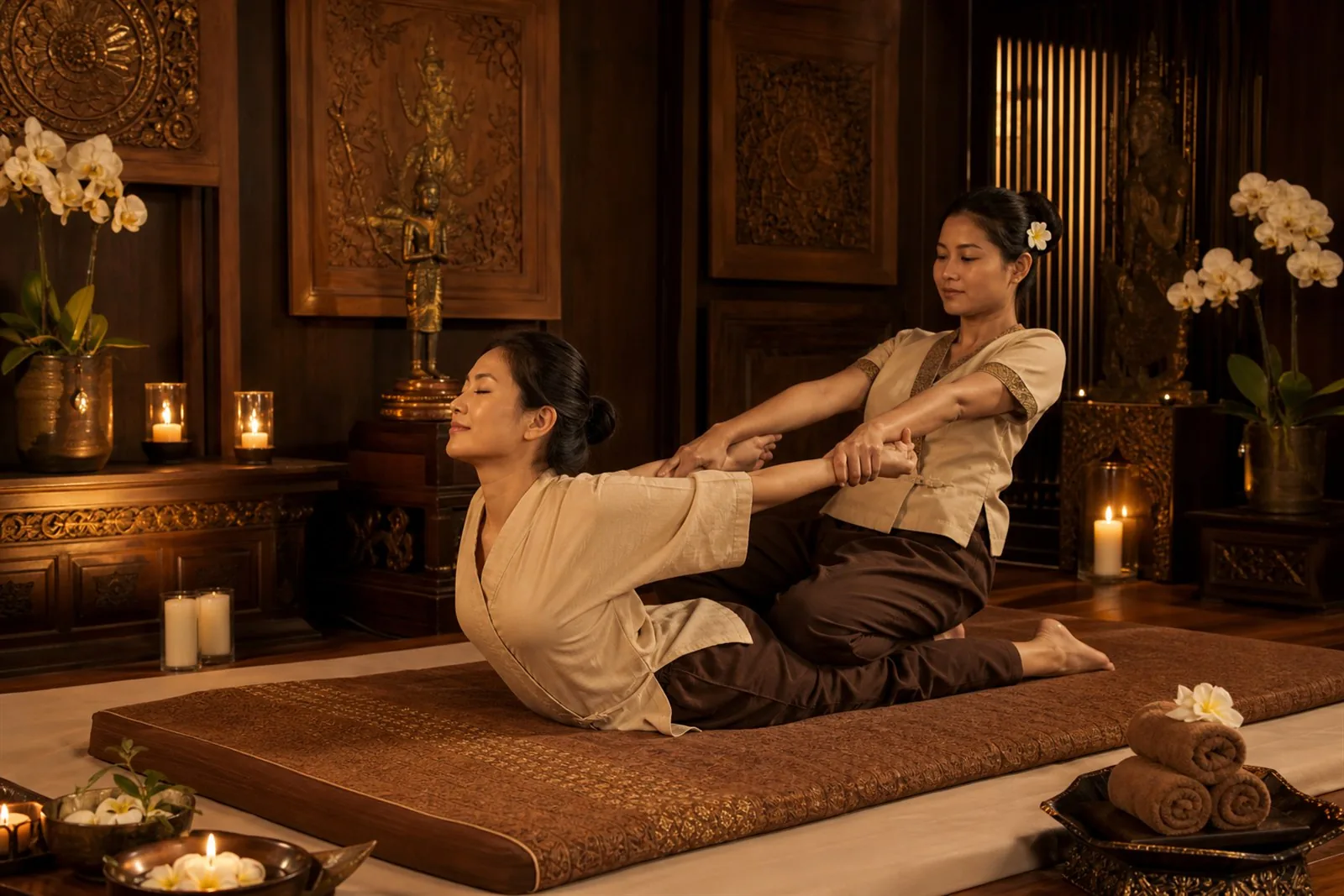
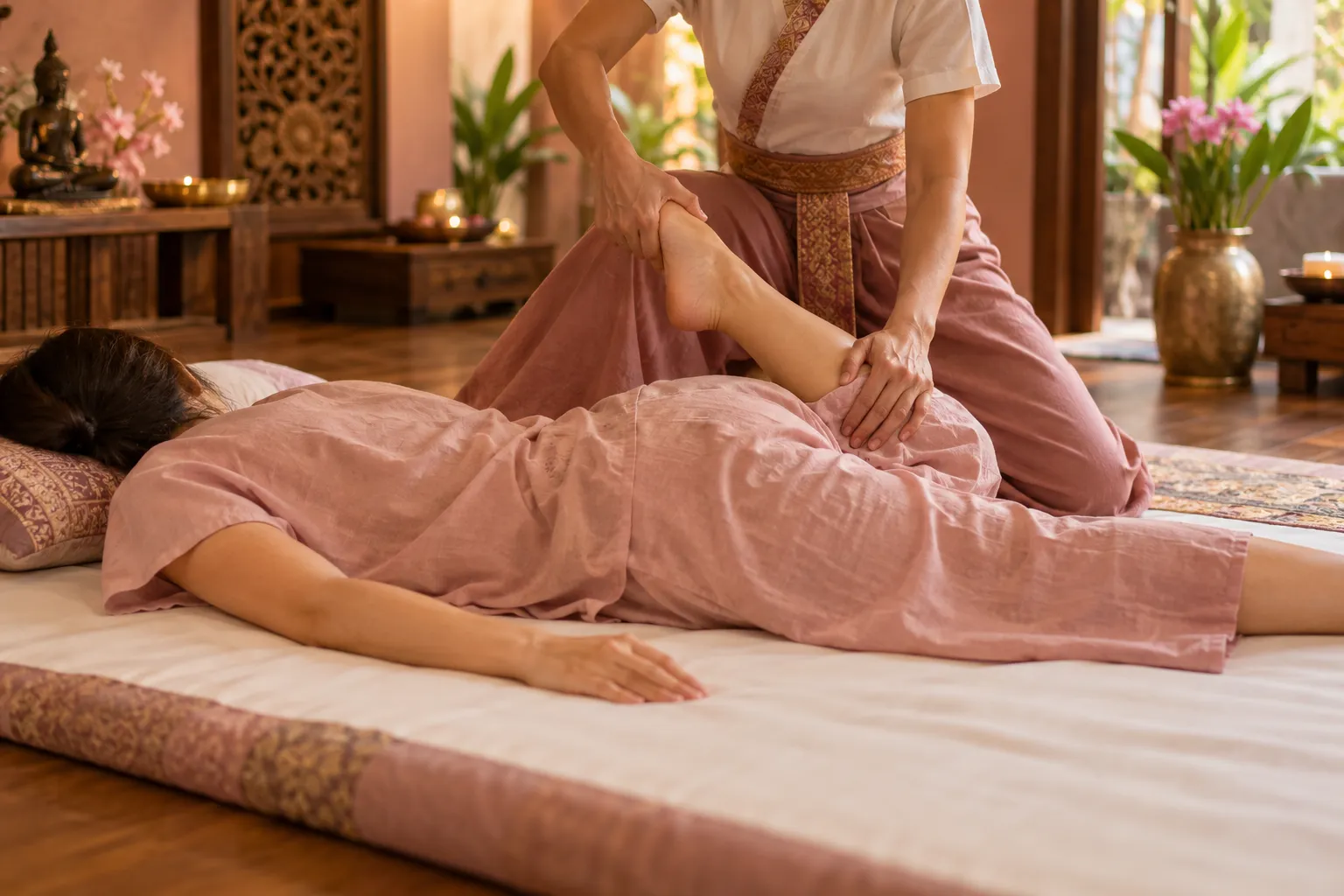
Thai massage grew out of traditional Thai medicine, a lineage quite separate from western massage. Rather than kneading muscle with oil, the therapist presses and releases along lines of the body (the sen lines of Thai tradition) and guides your limbs through a set order of stretches. Palms, thumbs, forearms, elbows, knees and sometimes feet all share the work.
It is taken seriously well beyond spa menus. In 2019 UNESCO inscribed Nuad Thai, traditional Thai massage on its Representative List of the Intangible Cultural Heritage of Humanity, describing it as part of the art, science and culture of traditional Thai healthcare. It is a living practice with a long lineage, not a spa invention.
On our menu it appears as Traditional Thai Massage, or yoga massage: acupressure combined with yoga-style stretches in a smooth, unhurried tempo, without oil, with you choosing the strength of the pressure.
How to tell a real Thai massage from a 'Thai' label
Plenty of good massages are given in spas with a Thai name and are not traditional Thai massage at all. Neither is wrong, but if the traditional style is what you are after, these are the signs you have booked it:
- You keep your clothes on. Loose, stretchy clothing, no undressing, no towels to arrange.
- There is no oil. If the description talks about oil gliding over your skin, it is an oil massage. It may be a lovely one, but it is a different treatment.
- You are moved. Your legs are lifted, folded and rotated, and your back is gently twisted. Expect to change position several times.
- The pressure presses and releases. It travels along the body in a steady rhythm rather than sliding in long strokes.
- You are asked how strong you want it. Both the pressure and the depth of each stretch should be yours to set.
If you do want oil, that is completely fine. Our comparison of traditional Thai and oil massage explains the difference, and the Swedish massage guide covers the firmest of our oil styles. Book them by name and nobody is surprised.
What happens in a traditional Thai massage session
Every therapist adapts the order to your body and your time, but a traditional sequence tends to run like this:
- A short conversation. Where you are stiff, where you are sore, anything injured or off-limits, and how firm you like it.
- Feet and legs. Thai massage traditionally starts at the feet and works upwards: palms pressing along the calves and thighs, then thumbs following the lines of the legs.
- Hips. Knee-to-chest folds, slow rotations and stretches for the hamstrings and outer hips. This is where many people feel the biggest change.
- Back. Pressure either side of the spine, often with you lying on your side or face down, and usually a gentle twist.
- Shoulders, arms and hands. Stretches that open the chest and shoulders, then pressure down the arms into the palms.
- Neck and head. Slower, lighter work at the base of the skull and across the scalp.
- A seated finish. Many sessions end sitting up, with a shoulder stretch or a twist, so you leave upright and awake.
Traditionally the massage is given on a firm padded mat on the floor, because the therapist works with their own body weight and a soft surface would swallow it. You do not need to be flexible. The therapist works inside your range, and any stretch can be eased or skipped. If you are nervous about intensity, our answer to whether Thai massage hurts explains what you should and should not feel.
"People come in for their shoulders. Quite often it is the hips that have been holding everything up, and once they let go the shoulders follow."
Siri therapist team
How long to book, and how to prepare
Thirty minutes is enough for one region (legs and hips, or back and shoulders) and suits a lunch break, because there is no oil to wash off before you go back to work. An hour gets through the whole body once, which makes it the sensible first booking.
Ninety minutes is where traditional Thai massage really comes into its own. The full sequence has room to breathe, the hip work is not rushed, and your therapist can come back to whatever was most stubborn. Two hours is for an afternoon you have given up to it entirely.
Wear something loose and stretchy without zips, belts or a stiff waistband, and leave heavy jewellery at home. Eat lightly beforehand; being folded at the hips on a full stomach is nobody's idea of a good time.
Then, at the start, mention any joint you would like treated carefully. Thai massage puts more load through the knees, hips and lower back than an oil massage does, so a knee that complains on stairs or a back that dislikes bending is exactly what your therapist needs to hear. The stretches can be changed around it in seconds, but only if they know.
Where to get Thai massage in Auckland: Viaduct or St Heliers
Both Siri spas offer the same traditional Thai massage, seven days a week from 10.00am to 8.00pm. The Viaduct is a little dearer; otherwise, choose the one that fits your day.
- Viaduct · Auckland CBD: 1B/124 Customs Street West, Auckland 1010 · 027-722-6564. 30 mins $65 · 60 mins $115 · 90 mins $165 · 120 mins $220. Traditional Thai at the Viaduct
- St Heliers · seaside village: 417A Tamaki Drive, St Heliers, Auckland 1071 · 027 654 6642. 30 mins $60 · 60 mins $105 · 90 mins $145 · 120 mins $195. Traditional Thai at St Heliers
- Public holidays: a 15% surcharge applies. Closed Good Friday, Christmas Day, Boxing Day and New Year's Day, and closed until 1.00pm on ANZAC Day.
If you are after a Thai massage in the Auckland CBD, the Viaduct is the practical choice. A clothed, oil-free treatment means you can walk straight back to the office or on to dinner by the harbour. If you live in the eastern bays (Mission Bay, Kohimarama, Glendowie), St Heliers is closer and quieter, and Tamaki Drive is right outside for a slow walk by the water afterwards.
When Thai massage is not the right booking
The honest limitation: if what you want is to lie still and be soothed, Thai is the wrong treatment. It is an active massage, and even at its gentlest you will be repositioned and stretched. Book aromatherapy for that week instead. It costs the same and nothing gets folded.
Thai massage is also not right if being stretched could hurt you. If you are pregnant, or have osteoporosis, a joint replacement, disc problems, hypermobility, a recent injury or recent surgery, check with your GP, midwife or physiotherapist first, and tell us when you book.
For everyone else, the simplest way to understand Thai massage is to book an hour and let your therapist show you. If you would like to know what people tend to notice in the days afterwards, read our piece on the benefits of Thai massage.
Common questions
At Siri's Viaduct spa in the CBD, traditional Thai massage is $65 for 30 minutes, $115 for 60, $165 for 90 and $220 for 120. At St Heliers it is $60, $105, $145 and $195. A 15% surcharge applies on public holidays.
Loose, stretchy clothes you can bend and fold in, without zips, belts or a stiff waistband. Traditional Thai massage is done fully clothed.
Traditional Thai massage uses no oil at all. If you would like an oil massage, book Swedish, aromatherapy, deep tissue or warm coconut oil instead. They are the same price as Thai at each branch.
Sixty minutes for a first visit. Ninety if you want the full sequence with time to return to stiff areas. Thirty minutes covers one region only, such as legs and hips or back and shoulders.